The Rise of ESG-Linked Commercial Insurance: Revolutionizing Corporate Risk Management

In an era marked by climate urgency, heightened social responsibility, and stringent regulatory oversight, the global corporate landscape is undergoing a massive paradigm shift. Companies are no longer evaluated solely on their quarterly balance sheets; Environmental, Social, and Governance (ESG) performance metrics have become critical indicators of long-term viability, resilience, and risk profile. Amid this transition, the financial sector has introduced a groundbreaking mechanism to align sustainability with corporate risk management: ESG-Linked Commercial Insurance. This innovative risk transfer model rewards businesses for achieving robust ESG milestones, creating a powerful synergy between corporate sustainability goals and financial optimization.
Historically, the corporate world viewed insurance as a transactional necessity—a reactive shield against potential disasters. However, as global risks evolve to include climate-induced physical assets damage, supply chain disruptions, changing labor standards, and complex compliance environments, the insurance industry is pivoting. By linking policy terms directly to ESG metrics, insurers are transforming commercial insurance from a passive safety net into an active catalyst for sustainable corporate evolution.
Understanding ESG-Linked Commercial Insurance
Traditional commercial insurance has historically relied on historical actuarial data to assess risk and calculate premiums. While effective for static environments, this retrospective approach often fails to account for forward-looking risk factors, particularly those associated with climate transition risks, changing societal values, and shifting corporate governance standards.
ESG-Linked Commercial Insurance bridges this gap by directly integrating an insured’s ESG performance into the underwriting process, policy pricing, and capacity allocation. Under this model, companies with strong ESG credentials—or those committing to verifiable, science-based ESG improvement pathways—are granted preferential terms. These incentives may include reduced premiums, enhanced coverage limits, lower deductibles, or expanded capacity. Conversely, businesses that fail to meet baseline ESG criteria or ignore sustainability risks may face higher premiums, restricted coverage options, or even exclusion from certain insurance markets.
By leveraging this model, insurers incentivize corporations to actively manage and reduce their ESG-related risks. It aligns the financial interests of the corporate buyer with the underwriting appetite of the carrier, establishing a framework where sustainable operations translate directly into measurable financial savings.
The Core Pillars: How ESG Metrics Affect Policy Terms
To appreciate how ESG-Linked Commercial Insurance works, it is essential to examine how each of the three pillars of ESG influences the underwriting process and policy structures:
1. Environmental (E) Integration
The ‘Environmental’ pillar focuses heavily on climate risk, carbon footprints, transition pathways, and resource conservation. Insurers are increasingly offering premium discounts or customized coverage enhancements to companies that adopt renewable energy, implement circular economy waste systems, or build energy-efficient infrastructure. For instance, commercial property policies may offer “green rebuild” endorsements, allowing insureds to rebuild damaged properties using sustainable materials and energy-efficient technologies that exceed building codes, often funded partially by the insurer.
2. Social (S) Integration
The ‘Social’ component evaluates how a company manages relationships with its employees, suppliers, customers, and communities. In commercial liability and Directors and Officers (D&O) insurance, underwriters assess labor standards, workplace health and safety protocols, diversity, equity, and inclusion (DEI) initiatives, and supply chain human rights standards. Companies with robust social safety frameworks are statistically less prone to class-action lawsuits, labor disputes, and severe reputational damage, making them highly favorable risk profiles for underwriters.
3. Governance (G) Integration
‘Governance’ addresses the system of rules, practices, and processes by which a firm is directed and controlled. In the context of ESG-Linked Commercial Insurance, underwriters closely examine board diversity, executive compensation alignment with sustainability metrics, shareholder rights, transparency in reporting, and cybersecurity protocols. Strong governance mitigates the likelihood of regulatory non-compliance, financial fraud, and catastrophic data breaches, thereby reducing the risk profile for D&O and cyber insurance lines.
Comparative Analysis: Traditional vs. ESG-Linked Commercial Insurance
To better understand the structural shift occurring in the corporate risk landscape, the following table compares traditional commercial insurance models with the newly emerging ESG-Linked structures:
| Feature | Traditional Commercial Insurance | ESG-Linked Commercial Insurance |
|---|---|---|
| Risk Assessment Focus | Historical actuarial data, physical asset values, and industry averages. | Forward-looking ESG performance metrics, climate transition plans, and governance structures. |
| Pricing Mechanism | Fixed premiums based on historical loss history and standard industry risk classifications. | Dynamic pricing tied to the achievement of pre-defined ESG performance targets (KPIs). |
| Value Proposition | Pure risk transfer and financial indemnification after a loss event occurs. | Active risk mitigation, capital cost reduction, and alignment with corporate sustainability goals. |
| Coverage Innovation | Standard indemnity limits and conventional policy exclusions. | Customized coverage, green building replacement options, and climate-resilience incentives. |
| Data Sources | Financial statements, physical property audits, and basic past claims history. | Third-party ESG ratings, carbon disclosure projects, sustainability reports, and real-time operational telemetry. |
Strategic Benefits for Corporations and Insurers
The adoption of ESG-Linked Commercial Insurance delivers multifaceted advantages across the corporate ecosystem. For policyholders, the most immediate benefit is financial. By linking ESG achievements to insurance pricing, organizations can unlock significant cost savings on their premium payments, directly reducing their overall Cost of Risk (CoR). Furthermore, participating in these programs signals to investors, rating agencies, customers, and prospective talent that the organization is deeply committed to sustainable practices, bolstering brand equity and market valuation.
For insurers, ESG-Linked Commercial Insurance serves as a vital tool for portfolio decarbonization, underwriting accuracy, and risk mitigation. By encouraging policyholders to adopt safer, greener, and more ethical practices, insurers actively reduce the frequency and severity of future claims.
“The future of risk management lies not in merely paying claims, but in actively partnering with businesses to prevent them. ESG-Linked Commercial Insurance represents a fundamental shift from reactive compensation to proactive risk mitigation, aligning economic prosperity with ecological and social resilience.”
The Role of D&O and Property Lines in ESG Linkage
While ESG-linked mechanisms can theoretically be applied across almost all insurance products, they have gained the most rapid traction in Directors and Officers (D&O) liability and Commercial Property lines.
In D&O insurance, executives face growing personal liability for corporate ESG failures. Shareholder lawsuits over “greenwashing”—the act of making misleading claims about a company’s environmental credentials—are on the rise globally. ESG-linked D&O policies reward companies that possess clear, auditable ESG disclosure processes and diverse boards, as these factors drastically reduce the risk of regulatory investigation, corporate malfeasance, and shareholder litigation.
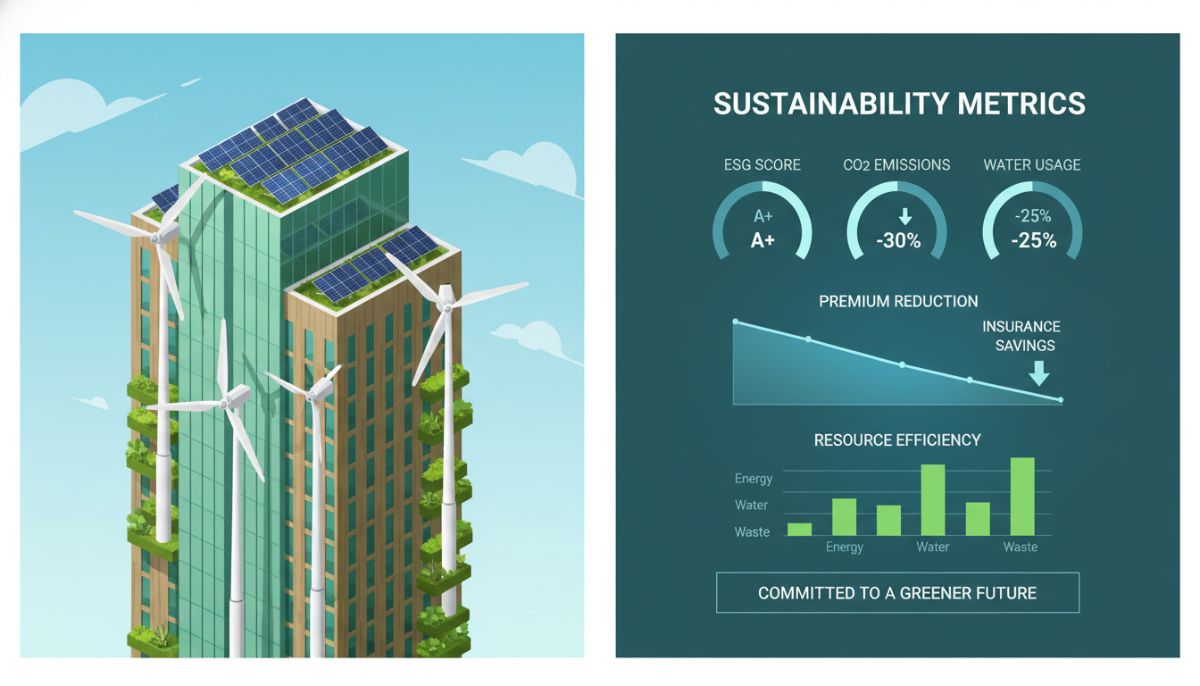
In Commercial Property insurance, climate-related natural disasters are driving up premiums and restricting capacity worldwide. Property owners who invest in climate-resilient construction, flood defenses, and renewable microgrids can leverage ESG-linked policies to secure premium relief and secure coverage capacity in high-risk zones where traditional coverage might otherwise be prohibitively expensive or unavailable.
Overcoming Implementation Challenges
Despite its immense potential, the widespread adoption of ESG-Linked Commercial Insurance faces several structural hurdles that the industry must address:
Data Standardization and Quality
The primary challenge is the lack of globally standardized metrics for measuring ESG performance. Insurers currently rely on a patchwork of third-party rating agencies, whose methodologies and scoring systems can vary dramatically. Without consistent, reliable, and auditable data, establishing fair and transparent performance-linked premiums remains highly complex.
The Threat of Greenwashing
As companies scramble to secure preferential insurance rates and satisfy investor demands, there is an inherent risk of greenwashing. Insurers must implement rigorous verification protocols and demand transparent, third-party audited ESG data to prevent greenwashing and protect the integrity of these financial products.
Evolving Regulatory Frameworks
The regulatory landscape surrounding ESG reporting is in a constant state of flux. Insurers and corporate policyholders must continuously adapt to new mandates, such as the EU’s Corporate Sustainability Reporting Directive (CSRD) and evolving SEC climate disclosure rules in the United States, which impact how data is collected and reported.
The Path Forward
As advanced data analytics, Internet of Things (IoT) devices, and climate modeling technologies mature, the underwriting of ESG-Linked Commercial Insurance will become increasingly precise and dynamic. We are moving toward a future where insurance premiums could adjust in real-time based on live environmental telemetry, supply chain audits, and governance decisions. Corporations that proactively integrate ESG principles into their operational DNA today will not only enjoy immediate insurance cost advantages but will also be uniquely positioned to survive and thrive in the low-carbon economy of tomorrow.
FAQ
What is ESG-Linked Commercial Insurance?
It is a specialized corporate insurance framework where policy terms, premiums, deductibles, or capacity are directly tied to the insured company’s ESG (Environmental, Social, and Governance) performance metrics or ratings.
How do companies benefit financially from these policies?
Companies with exceptional ESG scores, or those that successfully meet agreed-upon sustainability key performance indicators (KPIs), can secure lower premium rates, expanded coverage limits, or more favorable deductibles, lowering their overall cost of risk.
What types of insurance lines are most affected by ESG integration?
Directors and Officers (D&O) liability, Commercial Property, and Environmental Liability lines are currently the most active areas for ESG linkage, though the practice is rapidly expanding into supply chain and cyber insurance.
How do insurers verify a company’s ESG claims and performance?
Insurers utilize a combination of independent third-party ESG rating agencies (such as MSCI or Sustainalytics), verified corporate sustainability reports, IoT-driven real-time data, and structured third-party audits to monitor compliance with agreed-upon KPIs.