Navigating the Legal Highway: A Comprehensive Guide to Autonomous Vehicle Liability

Introduction
The automotive landscape is undergoing its most revolutionary transformation since the invention of the internal combustion engine. As artificial intelligence (AI) and sensor technologies advance, autonomous vehicles (AVs) are transitioning from experimental concepts to tangible realities on public roads. However, this technological leap introduces a complex, multi-layered conundrum that sits at the intersection of technology, ethics, and jurisprudence: autonomous vehicle liability.
For over a century, traffic laws and auto insurance frameworks have operated under a foundational premise: human error is the primary cause of traffic accidents. When a collision occurs, law enforcement and insurers investigate which driver was negligent. With the rise of self-driving technology, this human-centric paradigm is rapidly dissolving. When a vehicle’s hardware, software, and sensors make the driving decisions, determining who is legally responsible for a mishap becomes an intricate legal puzzle. This comprehensive analysis explores the evolving landscape of autonomous vehicle liability, examining legal theories, regulatory challenges, and the future of accountability on the automated road.
Defining the Shift: From Driver Negligence to Product Liability
Historically, motor vehicle accidents have been governed by tort law, specifically under the doctrine of negligence. To succeed in a negligence claim, a plaintiff must prove that the driver owed a duty of care, breached that duty, and directly caused damages. However, as vehicles assume dynamic driving tasks, the locus of control shifts from the human operator to the vehicle manufacturer and software developer.
The Rise of Product Liability
In the era of autonomous vehicles, legal scholars and practitioners widely agree that liability will transition from traditional driver negligence to product liability. When an autonomous system fails—whether due to a coding anomaly, a sensor blind spot, or a hardware defect—the vehicle itself becomes the focus of the litigation. Product liability claims typically fall into three distinct categories:
1. Manufacturing Defects: Physical flaws that occur during the assembly of the vehicle or its components (e.g., a faulty camera lens or a corrupted LIDAR sensor).
2. Design Defects: Inherent flaws in the product’s design or algorithm that make it unsafe, even if manufactured perfectly (e.g., an autonomous driving algorithm that fails to recognize pedestrians in low-light conditions).
3. Inadequate Warning/Instructional Defects: A failure by the manufacturer to properly instruct users on the limitations of the technology or warn them of foreseeable risks.
The Hybrid Liability Era
We currently reside in a transitional phase where vehicles possess varying degrees of autonomy, often requiring human drivers to remain vigilant and intervene when necessary. This hybrid model complicates the application of autonomous vehicle liability, creating a grey area where insurers and courts must untangle the contributions of both the human operator and the automated driving system.
Classification of Autonomous Vehicles and Liability Implications
To understand how liability is distributed, it is essential to reference the Society of Automotive Engineers (SAE) levels of driving automation. These levels, ranging from Level 0 (no automation) to Level 5 (full automation), dictate the legal expectations placed upon the human operator versus the vehicle system.
| SAE Level | Automation Category | Human Role | System Role | Primary Liability Exposure |
|---|---|---|---|---|
| Level 0 to 2 | Driver Support | Must actively drive, supervise, and intervene instantly. | Provides steering, braking, or acceleration support. | Mainly Human Driver (Traditional Negligence) |
| Level 3 | Conditional Automation | Not driving but must be ready to take control upon request. | Monitors environment and executes all driving tasks under specific conditions. | Shared Liability (Complex apportionment between Driver & Manufacturer) |
| Level 4 | High Automation | No intervention required in specific operational design domains (ODDs). | Fully controls vehicle within defined geographical or weather parameters. | Mainly Manufacturer (Product Liability within ODD) |
| Level 5 | Full Automation | Occupant is purely a passenger; no driving controls required. | Handles all driving tasks under all conditions. | Solely Manufacturer/Developer (Strict Product Liability) |
As illustrated by the data above, Level 3 automation presents the most significant legal and safety challenges. The transition phase—where a vehicle suddenly requests a human occupant to retake control within a matter of seconds—presents extreme risks. If a collision occurs during this handoff, establishing autonomous vehicle liability requires meticulous data forensic analysis to determine whether the system gave adequate warning and whether the human responded in a reasonable timeframe.
Key Determinants in Establishing Autonomous Vehicle Liability
To successfully adjudicate cases involving self-driving car accidents, legal systems must rely on new forms of evidence and technical parameters. Several key determinants will dictate how liability is assigned:
1. Data Logs and Black Box Forensic Analysis
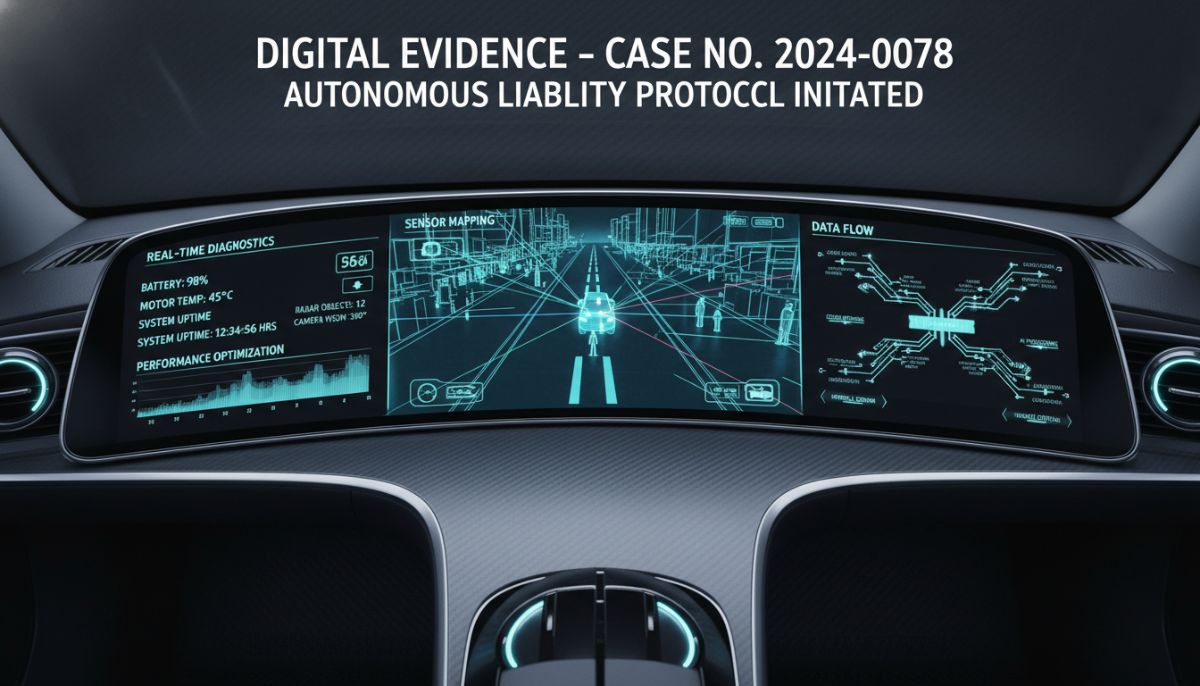
Unlike human drivers, autonomous vehicles continuously record vast streams of telemetry data. Event Data Recorders (EDRs) and onboard computers capture sensor inputs, algorithmic decisions, steering angles, and braking metrics leading up to an event. Accessing and interpreting this data is crucial. It answers the fundamental question: Was the autonomous system engaged, and did it behave as designed?
2. Cybersecurity and Software Integrity
As highly connected internet-of-things (IoT) devices, AVs are vulnerable to cyber threats. If a malicious actor hacks into a vehicle’s network and causes a crash, where does the autonomous vehicle liability lie? Manufacturers may be held liable if they failed to implement robust, industry-standard cybersecurity measures, while third-party developers could face liability for software vulnerabilities.
3. Operational Design Domain (ODD) Compliance
Manufacturers define the specific environmental, geographical, and time-of-day parameters under which their AV systems can operate safely. If a user forces the system to operate outside its designated ODD, or if the manufacturer fails to program the vehicle to automatically disengage or safe-stop when leaving its ODD, liability boundaries become highly contested.
“The shift toward autonomous vehicle liability will compel the legal industry to pivot from reconstructing human memories to decoding millions of lines of algorithmic data. The trial lawyers of tomorrow must be as proficient in software engineering as they are in cross-examination.”
— Legal Tech & Automotive Law Policy Institute
The Evolving Role of Insurance and Regulatory Frameworks
The transition to autonomous vehicles will fundamentally reshape the multi-billion-dollar automotive insurance sector. Currently, personal auto insurance policies dominate the market. As vehicles become fully autonomous (Levels 4 and 5), the need for individual liability insurance will likely decline, giving rise to massive commercial product liability policies held by fleet operators, ridesharing networks, and automotive manufacturers.
Several jurisdictions are already drafting novel frameworks to address this shift:
- The United Kingdom: The Automated and Electric Vehicles Act (AEVA) provides a unified approach, ensuring that victims of accidents involving automated vehicles are compensated quickly by the insurer, who then retains the right to recover those costs from the manufacturer if a system defect is identified.
- The United States: Lacking a unified federal framework, autonomous vehicle liability is governed by a patchwork of state-level statutes, with states like California, Arizona, and Florida leading the way in establishing testing and liability guidelines.
- The European Union: The EU is actively updating its Product Liability Directive to explicitly cover software defects, AI-driven decisions, and cybersecurity failures, laying a strong foundation for consumer protection.
Conclusion
The path toward fully autonomous transportation promises to dramatically reduce the frequency and severity of traffic accidents, the vast majority of which are currently caused by human error. However, the eradication of human error does not mean the eradication of accidents. When collisions do occur, the legal system must be prepared to handle the complex, data-driven nature of autonomous vehicle liability.
By shifting the legal focus from driver negligence to product liability, incorporating advanced data forensics, and establishing harmonized regulatory frameworks, society can foster technological innovation while ensuring robust protection and fair recourse for all road users.
FAQ
Q1: Can a passenger in a fully autonomous (Level 5) vehicle be held liable for a crash?
In a truly Level 5 autonomous vehicle, where there are no steering wheels, pedals, or manual controls, an occupant is legally considered a passenger. Consequently, they cannot be held liable for a collision caused by the vehicle’s driving decisions. Liability in this scenario would fall squarely on the manufacturer, software developer, or fleet operator, provided the passenger did not physically interfere with the vehicle’s mechanical functions or ignore critical safety warnings.
Q2: How will insurance companies determine fault in an accident involving both a human driver and a self-driving car?
In collisions involving a mix of human-driven and autonomous vehicles, insurers and legal teams will use a comparative negligence framework. This process relies heavily on the autonomous vehicle’s data logs (EDR data) and external cameras alongside traditional police reports. By comparing the millisecond-by-millisecond actions of the autonomous system with the actions of the human driver, investigators can apportion a percentage of fault to each party.
Q3: What happens if an autonomous vehicle crashes due to an unmapped road hazard or extreme weather?
If a self-driving car crashes due to unforeseeable environmental conditions, liability depends on whether the vehicle was operating within its designated Operational Design Domain (ODD). If the manufacturer claimed the vehicle could navigate heavy rain, but the sensors failed to do so safely, the manufacturer faces product liability. However, if the system warned the driver to take control due to extreme weather and the driver failed to do so, the liability may shift back to the human operator.
Q4: Will software updates change who is liable over the lifespan of an autonomous vehicle?
Yes, continuous over-the-air (OTA) software updates introduce unique liability challenges. If a manufacturer rolls out a software update that inadvertently introduces a bug or alters the vehicle’s driving behavior for the worse, the manufacturer or software publisher faces direct liability for subsequent failures. Conversely, if a vehicle owner fails to install a critical safety-related software update mandated by the manufacturer, the owner may be held liable for subsequent accidents caused by the unpatched system.